
Every clip costs a full re-watch
The fortieth clip costs the same as the first: another pass over the whole file to find the moment you half-remember.
Paste a YouTube link or upload the file. SnipHawk transcribes it word by word, scores every moment in it, and hands back a ranked list of clips — already reframed, already captioned, ready to export.
Access is opened in small batches. No card, and no obligation.
Finding the clips in a ninety-minute recording is a manual job. Watch it back, mark the times, cut each one, reframe it, caption it, export it. Five clips is an afternoon. Most weeks that afternoon doesn't happen, and the episode goes out once instead of nine times.
The fortieth clip costs the same as the first: another pass over the whole file to find the moment you half-remember.
A wall of timestamps tells you what was said. You still have to pick, and picking is the part that takes the time.
The channels that reward volume won't wait for your free afternoon. The back catalogue keeps getting further behind.
Paste a YouTube link or upload the file. Sources up to four hours long, on the highest plan.
Word-level transcription across the whole source, then every candidate moment is scored and ordered into up to fifteen clips.
Preview the clip in 9:16, 1:1 or 16:9. Choose the framing and the caption style. Trim if it cut a beat late.
MP4 up to 1080p, captions burned in, named so you know which clip is which.
Every suggestion is a real time range from your own transcript, scored on two independent tiers and sorted by strength. You get the ranking, a score label, a suggested title and a plain-English reason — so approving one takes seconds, and you can see exactly what was valued.
Opens with a concrete number, resolves inside a minute, and needs no setup from the rest of the episode.
A contrarian claim stated plainly, then a specific alternative. The disagreement is the hook.
Self-contained story beat with a quotable last line, short enough to hold without a trim.
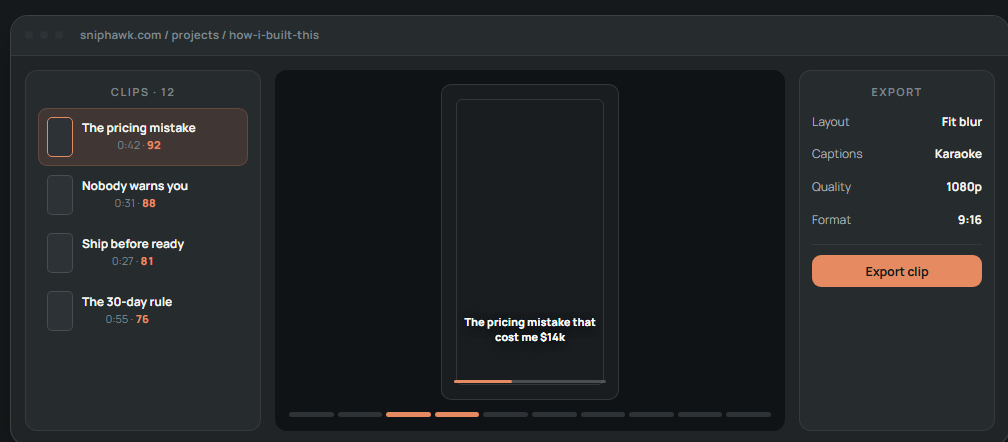
An example shortlist, showing the score label and reason that come with every suggestion. Nothing on it is invented: each clip is a time range from that recording's own transcript.
A sixteen-by-nine recording becomes a nine-by-sixteen clip that still looks intentional. Pick the fill that suits the footage — or, for a two-person conversation, keep both people in one vertical frame instead of cutting between them every four seconds.
Timing comes from the word-level transcript, so each line is placed where it was actually spoken. Choose a background treatment, tweak the style, and the preview you approved is the composition that gets exported. Karaoke style highlights each word as it's said.
| What you're comparing | Transcript tools | SnipHawk |
|---|---|---|
| What comes back | A transcript and a blade | A ranked shortlist of up to 15 clips |
| Finding the moment | You read, then guess | Scored, ordered, and explained in a sentence |
| Framing | Manual crop, clip by clip | Smart Fill, Fit Blur, Fit, Center Crop, split-screen |
| Captions | Auto-captions you re-time by hand | Word-level timing from the transcript |
| Getting it out | Download, then upload manually | MP4 per clip, 9:16, 1:1 or 16:9, up to 1080p |
Worth saying plainly, because the opposite is usually what these tools promise.
Every suggestion is a time range from your own recording. The scoring ranks and explains moments; it doesn't write them.
SnipHawk exports the file. Where it goes, and when, is still your call.
Working copies of your source are deleted on a schedule, and you can delete a project yourself at any time.
Put the last one in. Take a month of posts out.
Request access